Most job ads promise a dynamic team and an exciting mission. The most honest job description we know promises the opposite: hard work, little affection and a lot of thankless drudgery. It is said to come from Thomas Edison, and it describes AI better than most of what is written about AI.
A hiring story from 1888
In the spring of 1888, Emil Kolben, a 25-year-old Czech engineer, was in New York looking for work. In the New York World he read that a foundry at Edison’s works in Schenectady, New York, had burned down. He sent a short application with a brief CV.
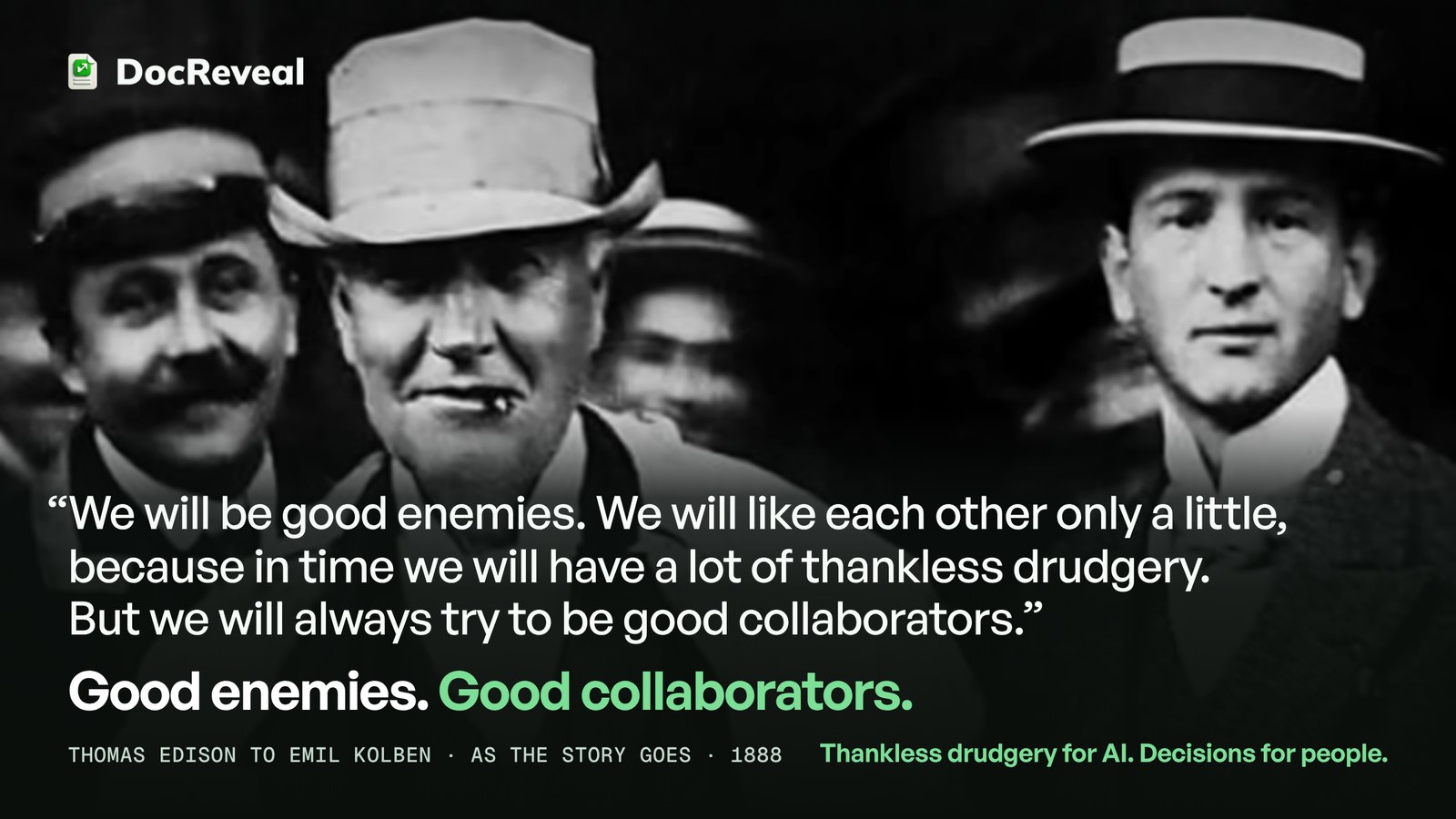
Edison’s reply, as Kolben wrote it down, fit on one line: if you can come right away, the job is yours. Kolben was in Schenectady that same evening. The story goes that Edison welcomed him with these words:
“We will be good enemies. We will like each other only a little, because in time we will have a lot of thankless drudgery. But we will always try to be good collaborators.”
No promises of passion. No grand vision. Just a fair working agreement: the work will be hard and often thankless, nobody has to love anybody, and both sides can rely on each other.
And it held. Edison brought Kolben to his laboratory in New Jersey and made him chief engineer. Then the two disagreed on the biggest technical question of their day: Kolben championed alternating current, the technology Edison fought in the “war of the currents.” They stayed friends anyway. Kolben went back to Europe and in 1896 founded his own electrical company in Prague. It later grew into ČKD, the maker of many of Prague’s trams. In 1911, Edison came to Prague to see what his former chief engineer had built.
One honest footnote, in the spirit of this article: Edison’s one-line reply comes from Kolben’s own notes. The longer welcome is how the story is usually told, but we could not trace it to a primary source. Read it as legend, not as a transcript.
Nobody joined your company to retype vendor invoices
Yet every new customer, vendor and shipment adds paperwork, and the back office grows with it. Purchase orders, delivery notes, invoices, credit notes, statements, bills of lading, contracts. Reading, retyping, checking, chasing.
Nobody likes this work, and nobody can skip it. One wrong digit or one invoice entered twice means a wrong payment, a missed discount or an awkward call from a supplier. So capable people spend their days copying numbers from one screen to another, and when volume grows, the usual answer is another hire.
That is the thankless drudgery of 1888, just with more PDFs.
Drudgery for the machine, decisions for your people
The hiring story from 1888 still makes the most honest job description for AI: the drudgery goes to the machine, the decisions stay with your people.
That is how DocReveal works. It is an AI platform for companies that run on documents: one platform reads and checks your documents, sends the data to your systems, answers questions with the source and hands the routine to AI agents. People approve only the exceptions.
- The machine takes the drudgery: reading every order, delivery note and invoice, scans and handwriting included, in any language and without templates; pulling out the data, checking it and sending it to your ERP and other systems.
- Your people keep the decisions: the exception that needs judgment, the supplier who needs a call, the payment that should wait.
The point is not a smaller team. It is a team that spends its time deciding instead of retyping. Volume can grow while the team stays the same.
You don’t have to love your AI. You do have to be able to check it.
Edison did not ask Kolben for affection. He asked for a collaborator he could rely on. That is the right standard for AI in your back office, and reliability is something you verify, not something you feel.
- Every answer points to its source. Every answer and every amount points to the exact place in the document it came from.
- AI agents work within the limits you set and ask before sensitive steps.
- Every processing step is on the audit trail. Ready for an audit.
And your documents are never used to train models. A good collaborator keeps what it reads to itself.
Write an honest job description for your AI
Before you bring AI into your back office, write its job description the way Edison might have. Four lines are enough:
- The drudgery. List the documents your team reads, retypes, checks and chases every week. That list is the job.
- The decisions. Write down which steps stay with people: approving payments, changing supplier records, anything you would not hand to a new hire on day one.
- The references. Require that every number can be traced back to its document. A tool that cannot show its source wants to be believed, not checked.
- The trial. Test it on your own documents, not on perfect samples. Ten to twenty of your real files tell you more than any slide deck.
We took our own advice and wrote DocReveal a CV. Its first line says “not human.”
Kolben and Edison never promised to like each other much. They promised to be good collaborators, and they kept that promise for more than twenty years, across an ocean and a fight over the future of electricity.
Thankless drudgery for AI. Decisions for people.