On a Wednesday afternoon at the end of October, the purchasing manager at Ferrostella Steel makes a decision in the team chat: from November, purchases without a purchase order can go up to CZK 20,000. Five people are in the thread. The purchasing directive still says CZK 15,000.
That is how most companies work. Limits, prices, exceptions and promises are agreed in chats, e-mails and meetings, and only some of them ever reach a document. Anyone who reads only the documents – a new colleague or an AI assistant – works from the old rules.
Our new video guide, One Context, Every Decision, shows how DocReveal closes that gap. It runs about six and a half minutes, you can watch it at the top of this page, and it follows one Monday morning at Ferrostella, a company that buys, cuts and delivers steel, in Knowledge Manager – the part of DocReveal that keeps what your company decided, agreed and promised.
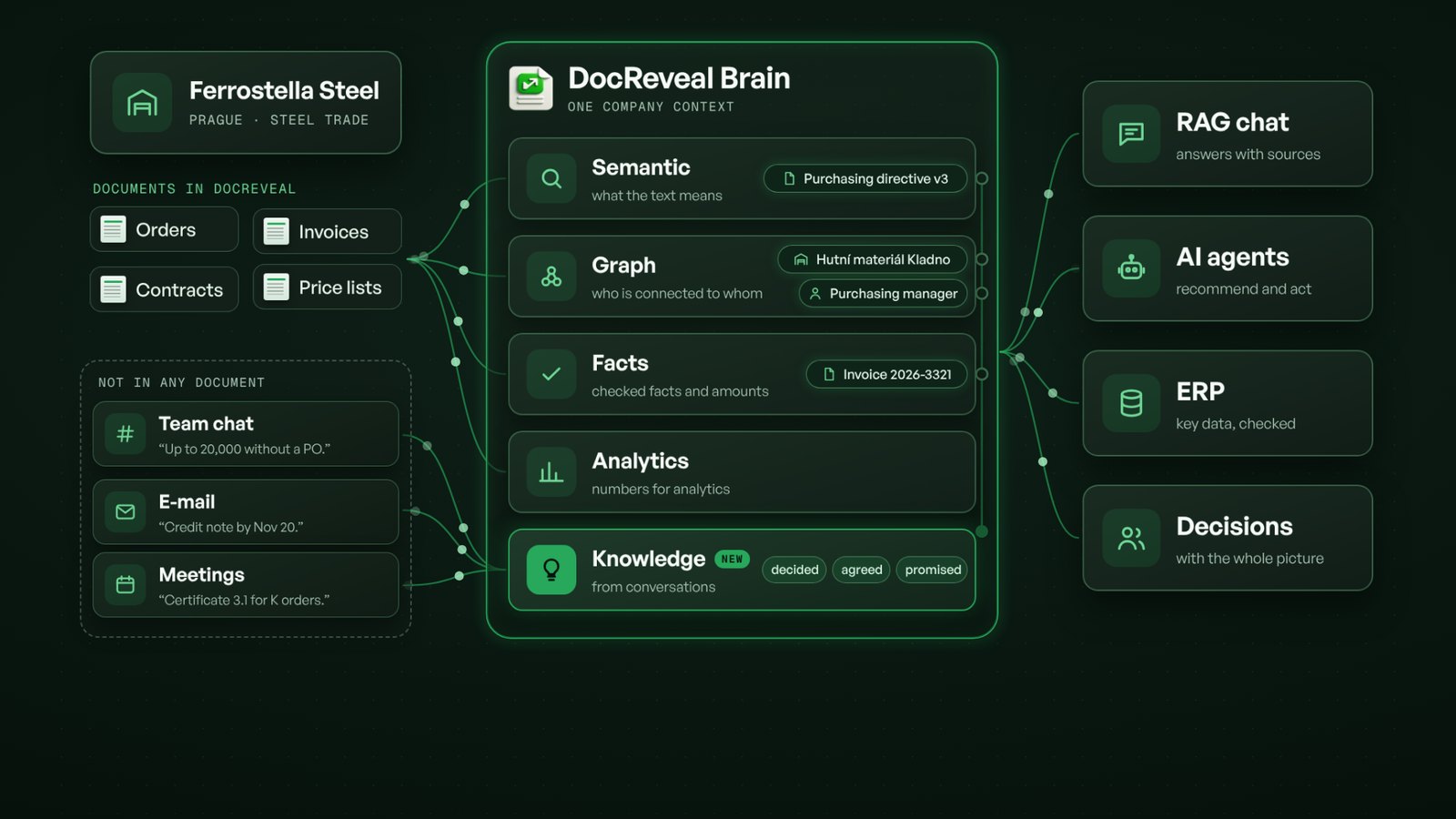
The DocReveal Brain: one company context, in layers
Ferrostella’s documents already live in DocReveal: orders, invoices, contracts and price lists. From them, DocReveal builds its Brain – one company context, made of layers that work together:
- Semantic – what the text means, so a question finds the right passage even when it uses other words.
- Graph – who is connected to whom: partners, people, contracts and documents. It is the company memory we described in People Move On, Your Company’s Memory Stays.
- Facts – checked facts and amounts, each pointing to the place in the document it came from.
- Analytics – the numbers, ready for reports, totals and trends.
Knowledge Manager adds a new layer: Knowledge – what was decided, agreed and promised at work, linked to the same documents, partners and people. With one context, the RAG chat and the AI agents recommend and act more precisely, key data from chats and e-mails reach your ERP, and people decide with the whole picture.
A new place for what you decided
Knowledge Manager sits in the DocReveal menu, right below Graph Manager. It keeps what was decided, agreed and learned at work, and every sentence in it has a source, a time and a validity: where it was said, when, and how long it applies.
The overview starts with what needs you today. At Ferrostella, six proposals wait for approval, two conflicts between a document and what was said wait for a decision, and three records wait to be verified. Below them is the company profile – a stable block of verified knowledge that the chat, the AI agents and connected AI assistants all start from.
It also shows what the memory brings: in the video, it was used in 412 answers and 96 agent runs in one month.
Plugged into the channels where decisions are made
Knowledge comes from sources: team chat channels, a shared mailbox such as the purchasing inbox, meeting transcripts, and DocReveal’s own chat and agents. Each source uses a connection from the Connection Hub – the same connections your integrations and agents use, managed in one place.
Not every message is worth remembering, so a filter without AI goes first: of 1,240 threads, 96 went on to extraction, and AI is spent only on those. The rules of each source decide what stays out – matters about a person never enter the memory.
From a thread to a record you can trust
Back to the thread from October 28: nine messages, five people. In message four, the purchasing manager raises the limit. DocReveal turns the thread into knowledge – a topic that is decided, a fact that replaces the old limit of CZK 15,000, and a commitment to update the directive. That commitment is now sixteen days overdue, and Knowledge Manager shows it. A passage about a person was left out.
In Records, every entry keeps its source, when it was said, from when it applies and what it replaces. When a document still says otherwise, both stay visible, so nobody has to guess which one is current.
AI proposes, people decide
Not everything that is said becomes company memory. By the rules of each area, a record is promoted automatically or proposed to a curator – the person who looks after that area.
In the video, a proposal is backed by two sources: in a breakdown, the shift supervisor may approve exceptions up to CZK 50,000. A curator agent has prepared it with a recommendation. The curator sees what changes and where it will be used, and approves. From that moment, the chat and the agents use it – and every step can be undone.
When an invoice and a team chat disagree on an amount, DocReveal does not pick a winner. It raises a conflict, and a person decides which applies.
One context for the chat, the graph, the agents and your ERP
The new layer is not a separate tool. It works inside the DocReveal you already use:
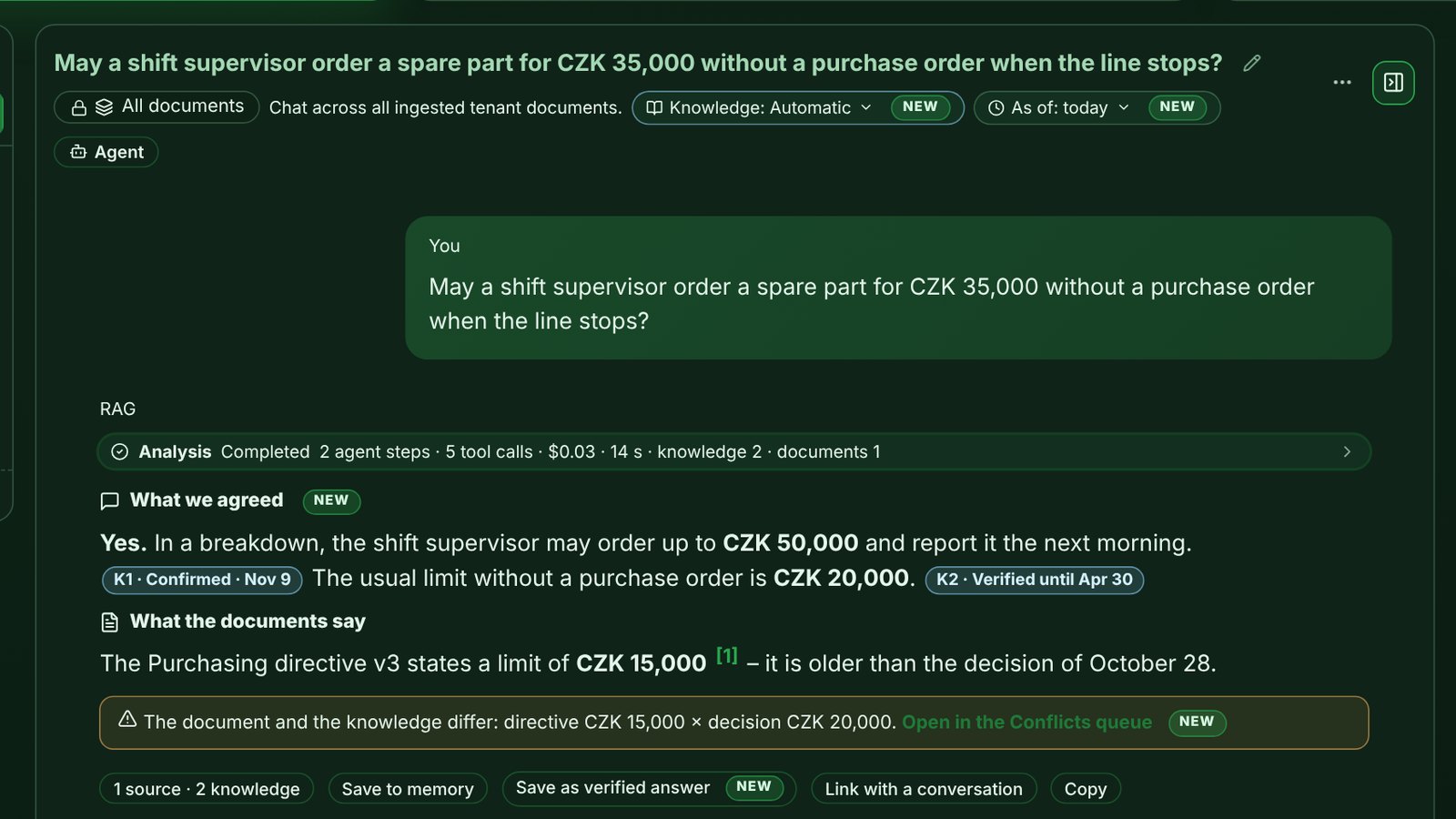
- RAG Manager – the chat reads knowledge next to documents, and you can ask as of a past date. Asked whether a shift supervisor may order a spare part for CZK 35,000 without a purchase order when the line stops, it answers yes – in a breakdown, up to CZK 50,000 – and shows, separately, that the directive still says CZK 15,000. The conflict goes to the curator’s queue.
- Graph Manager – every partner has a From work tab. For Ferrostella’s steel supplier, it shows a price increase of 6.5% from January, confirmed by a document, a credit note promised by November 20, a precedent and an open question. If the credit note does not arrive on time, a watcher moves it to To resolve.
- Agent Manager – each agent gets knowledge equipment: the areas it reads and memory tools such as precedents and the timeline. The contract watcher knows the supplier promised a credit note, so it recommends holding the payment of the invoice until it arrives. What an agent learns always goes to a curator first.
- Integration Manager – memory events start flows. When the curator approves the new price list, a flow writes the prices to the ERP: fourteen items, each with a link to its source.
What this means for you
- Answers that reflect today. The chat and the agents work from what your company decided, not only from what was written down months ago.
- Decisions that stay. What was agreed in a chat, an e-mail or a meeting stays findable – with its source, its time and its validity – even when the people who agreed it move on.
- Systems that stay current. Key data from conversations, such as new prices, reach your ERP – approved by a person and linked to the source.
- Conflicts on the table. When a document and a conversation disagree, you see it before anyone acts on the wrong one, and a person decides.
- Control stays with you. Rules decide what enters the memory, matters about a person stay out, a curator approves what becomes company knowledge, and every step can be undone.
Ferrostella, its partners and its people are fictional demo data.
Documents and conversations, in one Brain – one context for every decision.